
Picture this: You’re trapped on a ship in the Arctic. The ice is closing in. Your crew has lost hope. And then, across the frozen wasteland, you see something that shouldn’t exist—a giant figure racing across the ice on a dog sled, disappearing into the mist.
The next day, you find a man—ordinary size, barely alive—clinging to a drifting piece of ice. His eyes look like they’ve seen hell itself.
This is how Mary Shelley drops us into Frankenstein, and honestly? It’s one of the most brilliant openings in literary history. Because we’re not just getting a horror story. We’re getting a confession.
The Boy Who Wanted to Play God
Let me introduce you to Victor Frankenstein.
He grew up in Geneva, surrounded by love. Beautiful Elizabeth, his adopted sister-soulmate (it’s complicated—this was 1818). Supportive family. The kind of golden childhood that should produce a well-adjusted adult.
But Victor had a problem: he couldn’t stop asking “why.”
Why does lightning split trees? What makes dead things… dead? What’s the spark that turns flesh into a living, breathing person?
You know how some questions are better left unasked? Yeah. Victor didn’t get that memo.
He goes to university and completely loses the plot. Stops writing home. Stops sleeping. Starts haunting graveyards and slaughterhouses, collecting body parts like some kind of macabre shopping spree. His goal? To create life from death.
And here’s the thing—he actually succeeds.
The Moment Everything Went Wrong
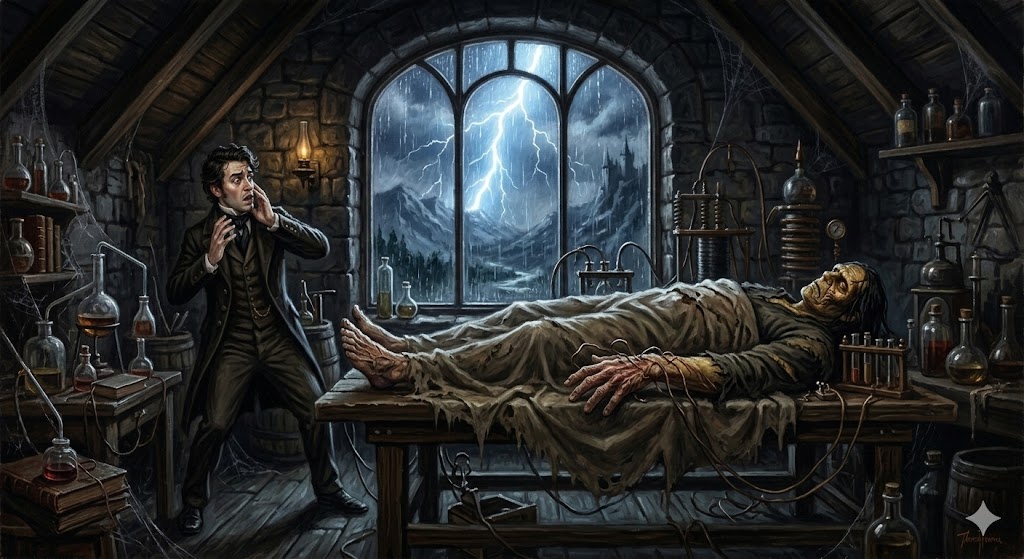
It’s a rainy November night. Victor has spent two years on this. He’s built an eight-foot-tall creature (because human-sized was too fiddly to work with, apparently). He applies the final spark.
The yellow eye opens.
And Victor’s immediate reaction?
He runs away screaming.
Look, I get it. The creature is described as pretty rough: yellow skin stretched too thin over muscles, black lips, watery eyes. But this is his creation. His “Adam.” And the first thing Victor does is abandon it.
The creature wanders into the house, tries to communicate—probably just wants comfort, connection, literally anything—and Victor flees into the storm. He literally runs from his own responsibility.
And honestly? That’s the real horror of this book. Not the monster. The creator who refuses to parent.
What Happens When You’re Rejected by Everyone
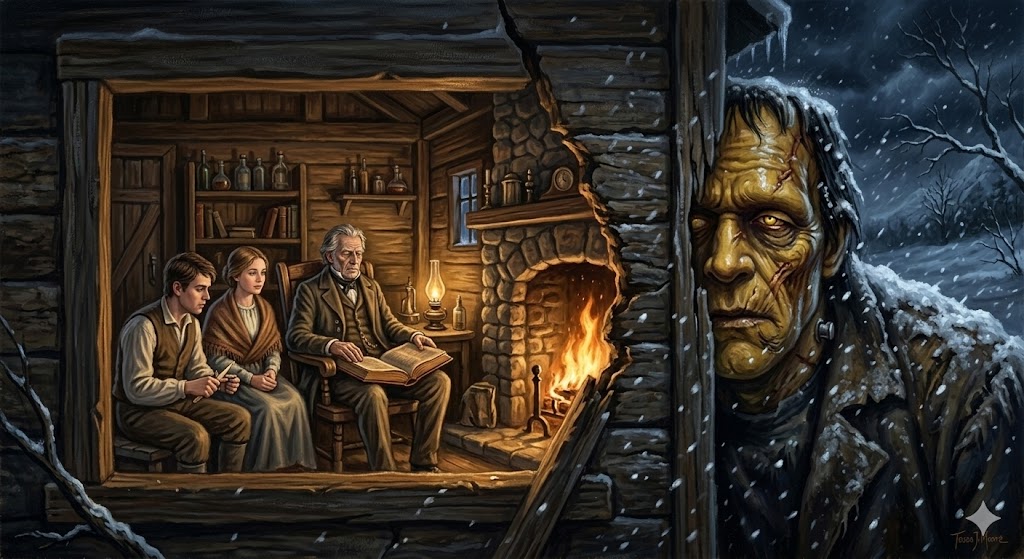
The creature’s story is where Mary Shelley does something revolutionary. She gives the “monster” a voice. And what does he tell us?
He started out gentle. Curious. Almost innocent.
He learned about fire (hot = bad). He learned about hunger. He watched a poor family through a crack in their cottage wall for months, teaching himself to read and speak by eavesdropping on their lessons. He did secret kindnesses for them—chopping wood at night, clearing snow.
He just wanted someone to see past his face.
But every single time a human saw him? Screaming. Rocks. Guns. Violence.
Even when he saved a drowning girl—rewarded with a bullet.
The blind man in the cottage was his last hope. “Surely,” the creature thought, “someone who can’t see me will judge me by my words.” And it worked! For about five minutes. Until the family came home and beat him senseless.
That’s the moment the monster is born. Not when Victor assembled his body. Not when the yellow eye opened. When love was refused.
The Deal and the Breaking Point
So the creature finds Victor on a glacier and tells him all this. And then he makes a proposal:
“Make me a companion. A female creature, as hideous as me. We’ll disappear into the wilderness and never bother humans again. Give me that, and I’ll be virtuous.”
Victor, feeling guilty and terrified, agrees.
But here’s where it gets interesting. Victor starts building the female creature on a remote island. And right as he’s about to finish, he panics:
What if they’re evil together? What if they reproduce? What if they create a whole race of monsters?
So he tears the female creature apart.
And the creature—watching through the window—lets out this howl of absolute despair. Then delivers the most chilling line in the book:
“I will be with you on your wedding night.”
Spoiler: he doesn’t mean he’s bringing a gift.
The Body Count Rises
Let’s tally this up, because Victor’s choices have consequences:
- William – Victor’s little brother, strangled by the creature
- Justine – framed for William’s murder, executed
- Henry Clerval – Victor’s best friend, murdered
- Elizabeth – Victor’s bride, murdered ON THEIR WEDDING NIGHT
- Alphonse Frankenstein – Victor’s dad, dies of grief
Victor thinks the creature is coming for him on the wedding night. He’s armed. He’s ready. He sends Elizabeth to their room “for safety.”
And then he hears the scream from the bedroom.
The creature understood Victor perfectly. He knew exactly where to strike.
The Chase
After Elizabeth’s death, Victor’s father dies. Victor has nothing left. No family. No love. No hope.
Just revenge.
He chases the creature across the world—through Russia, into the Arctic. The creature leaves taunting messages carved into trees. It’s this twisted game of cat and mouse where both participants are completely broken.
Victor gets his sledge. He gets his dogs. He gets close.
And then the ice breaks, and Victor ends up on Walton’s ship, telling this whole story as he slowly dies.
The Creature’s Last Words
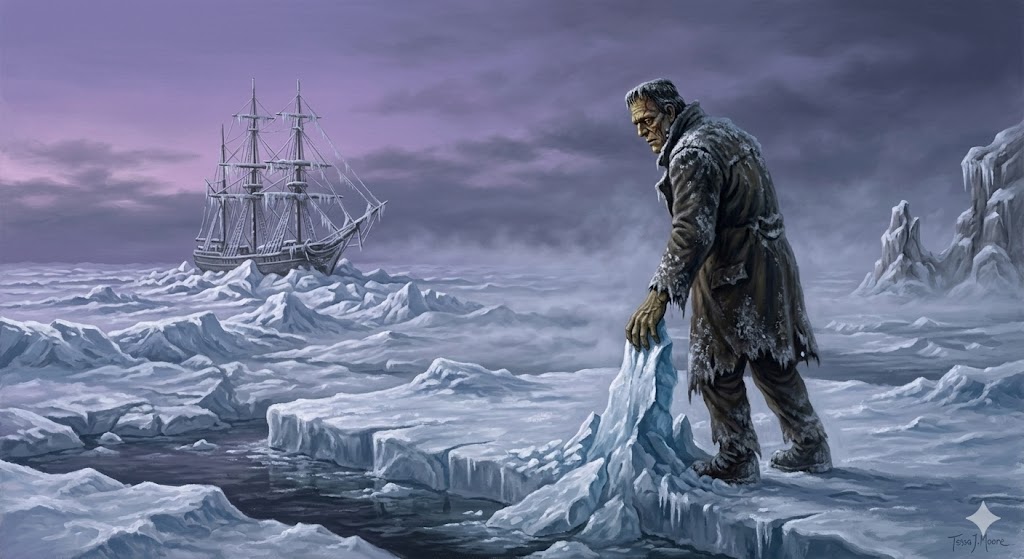
After Victor dies, Walton finds the creature in Victor’s cabin, weeping over the body.
This is important: the creature cries.
He’s not triumphant. He’s not gloating. He tells Walton that killing Victor was like cutting his own last tie to existence. He calls himself more miserable than Victor ever was.
Then he disappears onto an ice raft, heading toward the North Pole to build his own funeral pyre.
“I shall die. I shall no longer feel the agonies which now consume me. My spirit will sleep in peace.”
Why This Book Still Matters
Published in 1818. Written by an 18-year-old woman, Mary Shelley, during a rainy summer in Switzerland. And it’s still one of the most powerful stories ever told.
Here’s what gets me:
Victor isn’t a villain. He’s just… incredibly irresponsible. He’s the guy who invents something dangerous and then acts surprised when it causes harm. He’s every tech CEO who launches AI without safety protocols. Every parent who has kids and then isn’t there for them. Every creator who falls in love with the idea of their creation but can’t handle the reality.
The creature isn’t a monster. He’s a neglected child who turns violent after being rejected by literally everyone. Shelley isn’t excusing his murders—he kills children, for God’s sake. But she makes us understand why.
The real horror isn’t the eight-foot-tall corpse-man. It’s the abandonment. The loneliness. The way we create our own demons by refusing to take responsibility.
What I Can’t Stop Thinking About
The creature learns to read by listening to Paradise Lost—you know, the epic poem about Satan rebelling against God. And he identifies with both Adam (created and abandoned) and Satan (rejected and vengeful).
He asks the question that haunts me:
“Who was I? What was I? Whence did I come?”
It’s the same question every abandoned person asks. Every neglected child. Every outcast.
And the answer Victor gives—through his silence, his running, his refusal to parent—is basically: “You’re nothing. You’re no one. You don’t deserve to exist.”
No wonder the creature burns everything down.
The Takeaway
Frankenstein isn’t a monster story. It’s a creation story. Not the biblical kind—the human kind.
What do we owe the things we make? Our children. Our art. Our technology. Our ideas. When we bring something into the world, do we have a responsibility to stick around? To guide it? To love it, even when it’s ugly?
Victor says no. He runs.
And we’re still living with the consequences.
The ice cracks. The wind howls. Somewhere out there, a creature weeps for his dead creator, and a dead creator weeps for everyone he lost. And Walton—the captain who could have been Victor, if he’d listened—turns his ship around and heads home.
Some stories you don’t need to chase to the ends of the earth.
They’re already inside you.
If you want to read the original 1818 text …