
The Secret That Refused to Stay Buried. The Shadow Over Innsmouth by H.P. Lovecraft is a masterpiece of cosmic horror that begins in the bitter winter of 1927, when the federal government conducted a secret investigation in the ancient, decaying seaport of Innsmouth, Massachusetts. The public only learned of it months later, when a series of raids led to the burning and dynamiting of countless empty, rotting houses along the abandoned waterfront. Most people dismissed it as another violent episode in the war against bootleggers. But those who paid closer attention wondered at the staggering number of arrests, the unusual military force deployed, and the eerie silence that followed. The prisoners vanished without trial, without charges, swallowed by rumors of disease and distant prisons. Innsmouth was left a ghost of itself, a place already half-dead, now slipping into a deeper silence.
I am breaking that silence now. I am the one who fled Innsmouth in terror in the early hours of July 16th, 1927. My frantic appeals sparked the entire investigation. For years, I stayed quiet, but now the story has grown cold, and a strange compulsion has taken hold of me. I need to speak of those few dreadful hours in that ill-omened town, to whisper of the blasphemous shadows I encountered. Perhaps in the telling, I can convince myself it was all a nightmare, and steady my nerve for the terrible decision I now must make.
The Shadow Over Innsmouth: A Young Man’s Curiosity
My journey to Innsmouth began with a tour of New England to celebrate my coming-of-age. I was a young man with an interest in history and genealogy, traveling cheaply by train and bus. In Newburyport, when I baulked at the train fare to Arkham, a ticket agent with a shrewd face offered an alternative. “There’s an old bus,” he said hesitantly. “It goes through Innsmouth. Not many folks around here will ride it. Runs at ten in the morning and seven at night. It’s a rattletrap, but it’s cheap.” The way he said “Innsmouth”—with a mixture of disdain and unease—immediately caught my curiosity. A town so disliked by its neighbors had to be unusual. I decided then and there to stop and see it for myself.
The agent grew more talkative, though his words were measured and careful. He described Innsmouth as a ruin, a once-prosperous port now fallen into desolation. He spoke of a single gold refinery owned by the mysterious Marsh family, and of old Captain Obed Marsh, who was said to have brought back strange things from the South Seas. He warned me of the Innsmouth look—a certain odd, unpleasant appearance some of the locals had, with bulging eyes that never seemed to blink, rough skin, and a strange, shambling gait. He advised against staying at the town’s lone hotel, the Gilman House, hinting that unpleasant things had been heard there at night. His final words were a caution: “I wouldn’t go at night if I were you. But a daytime trip? Couldn’t hurt.”
The Tiara That Whispered of Ancient Evil
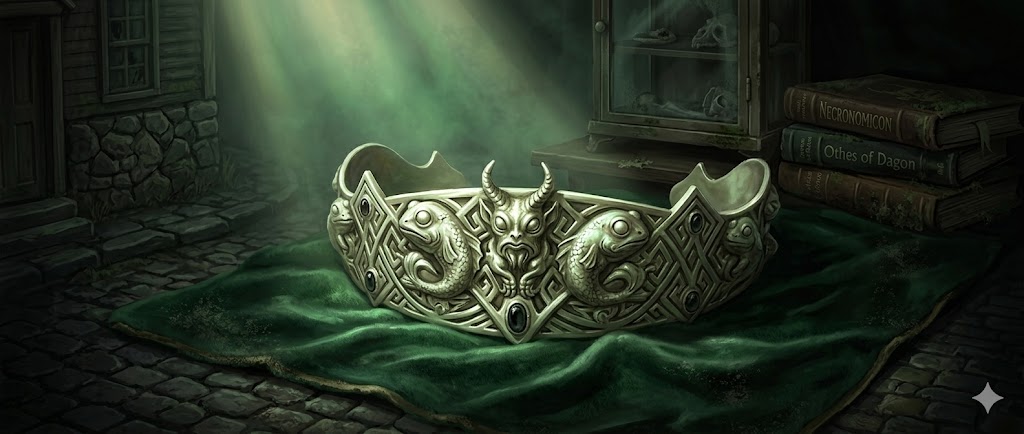
That evening, I visited the Newburyport library. The townspeople were even more reticent than the agent, turning away my questions with suspicious glances. The library’s histories had little to say, except that Innsmouth had been founded in 1643 and was once a great shipbuilding center. The epidemic and riots of 1846 were mentioned only in passing, as if they were a shameful secret. Most intriguing was a reference to strange jewelry associated with Innsmouth, with pieces displayed at the local historical society. Driven by an impulse, I secured an introduction to the curator, Miss Anna Tilton, who kindly let me in to see the artifact.
It was a tiara, resting on a velvet cushion under the electric light. I gasped at the sight. It was made of a gold-like metal with a strange, unearthly sheen, and it was crafted with a skill that defied any tradition I knew—Eastern or Western, ancient or modern. Its designs were both geometric and marine, with reliefs of monstrous, half-fish, half-frog creatures that stirred in me a deep, primal dread, a sense of pseudo-memory as if I had seen these horrors in some forgotten nightmare. Miss Tilton believed it was part of a pirate hoard discovered by Captain Obed Marsh. She also spoke of a debased cult in Innsmouth called the Esoteric Order of Dagon, which had absorbed all the orthodox churches. Her words did not deter me; they only fueled my anthropological curiosity. That night, I lay awake in my small room, my mind churning with architectural, historical, and now supernatural anticipation.
The Bus and the First Glimpse of Horror
The next morning, I stood before Hammond’s Drug Store, waiting for the Innsmouth bus. As the decrepit, dirty-grey vehicle rattled to a stop, I felt my first real wave of unease. The few passengers who disembarked were dark, unkempt men who shuffled away silently. The driver, Joe Sargent, was a stoop-shouldered man whose appearance sent a spontaneous chill through me. He had a narrow head, bulging, watery blue eyes that never seemed to blink, and a strange, grayish, almost scaly texture to his skin. His hands were large, with short, thick fingers. An overwhelming smell of fish clung to him. I was the only passenger to board. Paying my fare, I took a seat far behind him, my heart already beating a little faster.
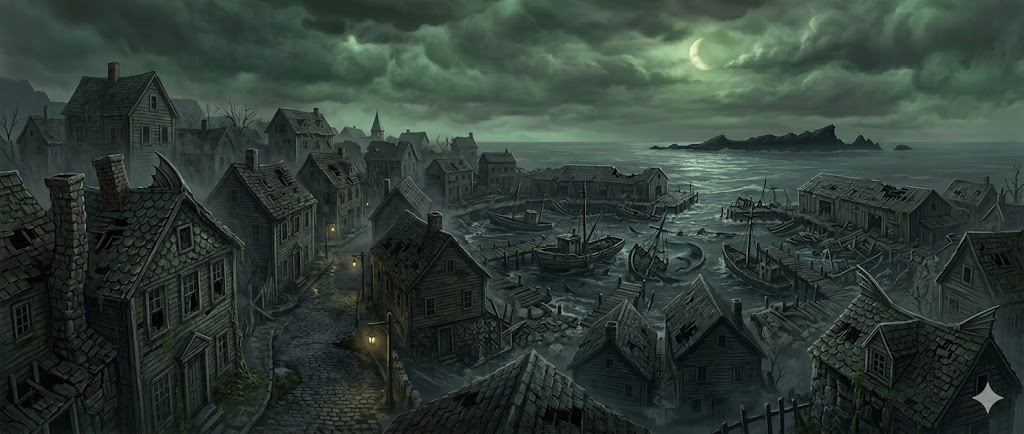
The bus lurched out of Newburyport, leaving the stately old homes for a landscape of increasing desolation: sand, sedge grass, and stunted shrubs. The air grew heavy with the salt smell of the sea. We passed crumbling foundations half-buried in dunes, remnants of a more fertile past that had died with the 1846 epidemic. Finally, we climbed a steep rise, and as we reached the crest, the valley of Innsmouth spread out before me, a panorama of profound decay under the warm sun.
It was a town of wide extent but with visible death. Chimney pots stood cold, tall steeples were stark and unpainted against the sky, one crumbling at its peak. A vast huddle of sagging, gambrel roofs conveyed an overwhelming sense of worm-eaten rot. Closer to the waterfront, the decay was absolute, though I could see the white belfry of what looked like a factory. The harbor was a sand-clogged basin enclosed by an ancient breakwater. And far out at sea, a long, black line barely broke the surface—Devil Reef. A subtle, grim sense of repulsion, mixed with an even more disturbing feeling of beckoning, washed over me as I looked at it.
We entered the town proper. The streets were narrow, shadow-blighted, and filled with a nauseating, pervasive odor of fish. The houses here were mostly boarded up, but some showed signs of habitation—rags stuffed in broken windows, shells and dead fish littering untended yards. The few people I saw were listless, their faces marked by that same odd, unpleasant look, with bulging, unwinking eyes. Their movements were furtive, shambling. A deep, instinctive dislike stirred within me.
The bus reached a sort of square. On one corner stood a large, pillared hall, its paint peeling, a faded sign reading “Esoteric Order of Dagon” just legible on its pediment. Across from it was a squat stone church. As I looked, its basement door stood open, a rectangle of pure blackness. Then something crossed that darkness—a figure in peculiar vestments, wearing on its head a tiara that was the twin of the one I had seen in Newburyport. The sight burned into my brain, a momentary image of nightmare that left me shaken for reasons I could not name.
Trapped: The Gilman House
I got out at the Gilman House, a tall, cupola-topped building that had once been yellow. The lobby was shabby and held only one elderly man who, notably, did not have the Innsmouth look. I checked my valise and escaped into the square, determined to explore. I decided to make my first inquiries at a chain grocery store, hoping the clerk would be an outsider. I found a bright, affable young man from Arkham who was clearly unhappy in Innsmouth. He spoke freely of the town’s furtive, hostile people, their disgusting fishy smell, and their strange, nocturnal chanting in the churches. He warned me to avoid the Marsh refinery, the churches, and the Order of Dagon Hall. “They’re all odd,” he whispered. “And some strangers have disappeared.”
He mentioned one source of information: a half-crazed, ancient drunkard named Zadok Allen, who lived at the poorhouse and was the only one who would talk, especially if lubricated with liquor. With a rough map drawn by the youth, I set out to explore the decaying architecture, but my plan for a detached, scholarly visit was already crumbling under the weight of the town’s oppressive atmosphere.
The southern part of town was a desert of collapsing warehouses and abandoned wharves. The silence was profound, broken only by the lap of harbor water and the distant roar of the Manuxet River falls. The sense of watching eyes from black, gaping windows became unbearable. North of the river was worse—traces of squalid life, with sounds that seemed to come from within boarded-up houses, suggesting the hidden tunnels the grocery boy had mentioned. The people here were even more hideously abnormal. A profound, skin-crawling dread settled deep in my bones.
Read Also: The Happy Prince and Other Tales
The Confession of Zadok Allen
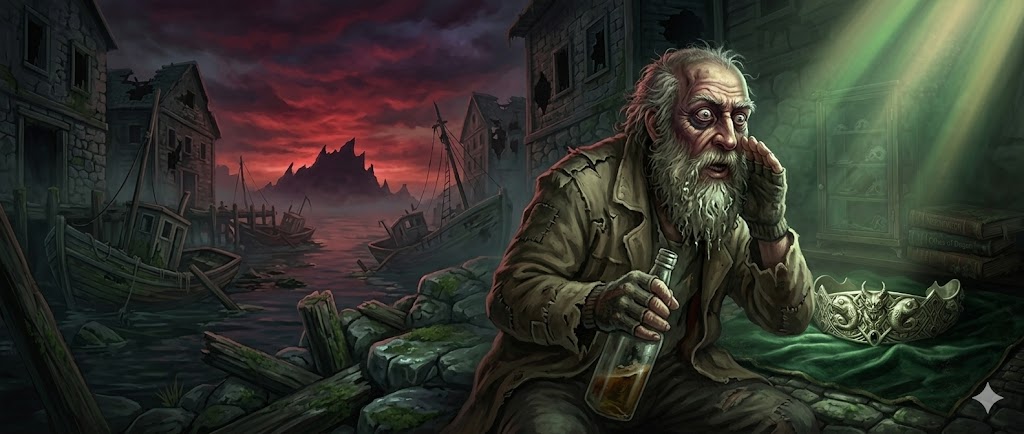
It was near the crumbling fire station that I saw him: an old man in rags, with a bushy white beard and watery eyes, talking to two firemen. This was Zadok Allen. My original plan to flee on the eight o’clock bus evaporated. A reckless, perverse curiosity seized me. I had to hear his tales. I bought a quart of bootleg whiskey and, by brandishing the bottle, lured the old man away from the square toward the deserted southern waterfront.
We settled on moss-covered stones near a ruined wharf, the fish-stench almost unbearable. For a long time, Zadok rambled on current events. But as the whiskey took hold and his gaze fell on the distant black line of Devil Reef, his tone changed. He leaned close, his breath foul, and began to hiss a tale of ancient wickedness.
He spoke of Captain Obed Marsh, who, in the 1830s, while trading in the South Pacific, discovered a remote island where the natives enjoyed boundless fishing and wore strange jewelry. They worshipped gods that lived under the sea—amphibious creatures, the “Deep Ones.” In return for human sacrifices, these creatures provided fish and gold. Worse, they could interbreed with humans. The offspring would appear human at first but would gradually change, eventually taking to the water to live eternally with the Deep Ones. Obed Marsh, seeing a chance for profit and power, brought this worship back to Innsmouth when the town’s fisheries failed. He made a pact. The Deep Ones would fill the harbor with fish and give gold. In return, they wanted a place to come ashore, to mix with the townsfolk, and to receive periodic sacrifices.
“There was an awful night in ’46,” Zadok whispered, trembling. “They came up from the reef… swarms of ’em… into the streets. There were shots and screams. When it was over, half the town was missing. The rest… they joined the Order o’ Dagon, or they kept quiet.” He said the Marshes and other old families now had terrible secrets hidden in their attics, that the older one got, the more the change took hold, until they finally went to live in the sea. He muttered of rituals on Devil Reef, of the strange tiara, and of the constant, hidden presence of the Deep Ones in the town’s watery tunnels. His voice rose to a hysterical shriek as he described seeing shapes on the reef as a child. “They’re bringin’ things up from below! They’re plannin’ to spread! Ever hear of a Shoggoth?!”
Suddenly, he screamed, his eyes bulging in terror at something over my shoulder toward the sea. “Git out! They saw us! Run for your life!” Before I could look, he scrambled up and dashed wildly inland, vanishing into the ruins. I saw nothing behind me but the incoming tide. But his raw, insane terror was infectious. The sun was low. I had to catch my bus and escape.
The Night of Terror Begins
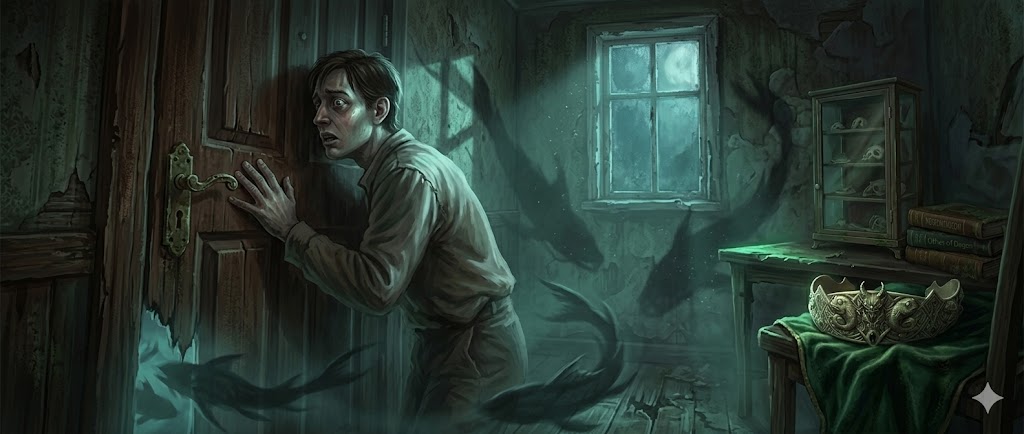
Back at the Gilman House, I learned my nightmare was just beginning. The bus, Sargent claimed, had broken down. No repairs until morning. No other way out of town. Trapped. With a sinking heart, I took a cheap room on the fourth floor. As twilight deepened into night, the town’s fear-shadowed silence became a palpable threat. I reinforced my door with a bolt from a wardrobe, my nerves stretched taut. I decided not to undress, to be ready for anything.
Then, in the dead of night, I heard it: a soft, furtive trying of the lock on my door. Then a passkey in the room next door. Then the attempt to connect the door. They were hunting for me, room by room. My blood ran cold. I knew then that Zadok’s ravings held a core of monstrous truth. I was prey.
The Flight Across the Rooftops
Cutting off the power, they plunged me into darkness. I could hear hoarse, barking croaks that were not human speech. Using my flashlight, I planned a desperate escape across the rooftops. As heavy battering began on my outer door, I smashed through the northward connecting door, barricading myself in the next room, then the next, moving like a cornered animal. I could hear my pursuers—their footsteps a strange, flopping patter, their voices guttural and alien. They did not speak; they croaked and bayed.
I used window draperies to lower myself onto the steep, slate roof of an adjacent warehouse, then dropped through a skylight into the black, dusty interior. I fled down skeletal stairs and out into a courtyard. Peering from a doorway, I saw them—a large crowd of doubtful shapes pouring from the Gilman House, lanterns bobbing. Among them was a robed figure wearing the familiar, blasphemous tiara. Their gait was a crouching, shambling horror. The fishy odor was overpowering.
Slipping through a ruined building to Washington Street, I began a frantic, stealthy flight south, aiming for the abandoned railway. The moonlit town was alive with pursuit. I saw a motor car full of hunched figures, and bands of them loping along other roads, cutting off my escape. The whole decaying hive was stirring. From a high point, I looked toward the Ipswich road and saw a distant, undulating column moving out of the city—a column that glistened too brightly and moved in an utterly wrong way.
The Procession of Nightmares
My only hope was the old railway line that ran northwest out of town. I reached the ruined station and began to run along the rusty tracks, the ties rotten and uneven. I crossed a terrifying, bat-infested covered bridge high over the river gorge. Finally, I entered a brush-grown cut, where I could hide. It was here that the Rowley road drew near. And it was here that the final horror found me.
The fishy odor became a choking miasma. A bestial babel of croaking, baying, and barking swelled on the road, mixed with a monstrous, collective flopping sound. I crouched in the bushes, trying to keep my eyes shut, but a terrible compulsion made me look. As the horde passed under the mocking yellow moon, I saw them clearly.
They were a limitless stream of nightmares—grayish-green, shiny and slippery, with white bellies and scaly ridges on their backs. Their forms were vaguely anthropoid, but their heads were the heads of fish, with prodigious, bulging eyes that never closed. Gills pulsed at their necks. Their long, webbed paws allowed them to hop irregularly on two or four legs. Some wore tall tiaras of that nameless whitish-gold metal. Some were robed. One that led them wore a humped black coat and a man’s felt hat perched on its shapeless head. They were the blasphemous fish-frogs of the tiara’s design, living and moving in a grotesque, malignant saraband. The sight stripped away my last vestige of sanity. I fainted dead away into merciful oblivion.
The Truth About My Blood
I awoke to gentle daylight rain, alone in the cut. Innsmouth lay quiet in the distance. I staggered to Rowley, then to Arkham and Boston, where I told my story to government officials. The great raids and clean-up that followed are now public knowledge. But my personal horror was only beginning.
Researching my own genealogy, I made a dreadful discovery. My great-grandmother was a Marsh of unknown origin. Old Zadok had muttered about the “true Marsh eyes.” The curator in Arkham had said I had them. The strange jewelry in my own family’s possession matched the tiara from Innsmouth. The staring, unwinking expression in the portraits of my grandmother and my uncle, who had killed himself after a trip to New England, now made a terrible sense. The dreams began soon after—dreams of vast, sunken cities, of swimming with the Deep Ones, of praying at their evil temples. I began to change. My health deteriorated. My reflection in the mirror slowly acquired the Innsmouth look.
The Call of the Deep
I dreamed I met my grandmother beneath the sea, in a phosphorescent palace. She told me she had never died. She had gone to Y’ha-nthlei, the city of the Deep Ones. She said it was to be my realm, too—that I could not escape it. I would never die. I would live with those who had lived since before man walked the earth.
I bought a pistol, intending to end it as my uncle had. But the dreams no longer frighten me. They call to me. A queer exaltation has replaced the terror. I feel drawn to the unknown sea-deeps. The stupendous, unheard-of splendors that old Zadok hinted at await me below. I will not shoot myself. Instead, I will free my poor, changed cousin from his sanitarium. Together, we will go to marvel-shadowed Innsmouth. We will swim out to that brooding reef, and dive down through black abysses to cyclopean, many-columned Y’ha-nthlei. And in that lair of the Deep Ones, we shall dwell amidst wonder and glory forever.
Final Thoughts
Thank you for staying with us until the very end. We hope this story touched your heart just as much as it did ours. H.P. Lovecraft had a unique gift for weaving tales that tap into our deepest, most primal fears—fears of the unknown, of the sea, of the darkness in our own blood.
We’d love to hear from you—let us know in the comments where you’re reading from and what part of the story resonated with you the most. Was it the slow descent into dread? The terrifying revelation of the Deep Ones? Or the narrator’s final, horrifying acceptance of his fate?
On a scale of 0 to 10, how would you rate today’s story?
If you enjoyed this post, please consider sharing it with someone who needs to experience this masterpiece of Cosmic Horror. Your support truly motivates us to keep bringing you more emotional and life-changing stories.
Before you go, there’s another classic story waiting for you. If you were moved by the themes of inheritance and inescapable fate in this tale, you’ll find similar depth in our analysis of Mary Shelley’s Frankenstein —another story about creation, responsibility, and the monsters we carry within.
Click the link below to continue the journey.
Thank you for being here, and we’ll see you in the next story.
Which part of The Shadow Over Innsmouth terrified you the most? Drop your thoughts in the comments below!