
An Immersive Retelling of the Classic Horror Novel of Vampires, Terror, and Undying Courage
There are stories that are told, and then there are stories that are felt. They seep into your bones like the damp cold of an ancient castle, they echo in your mind long after the final page is turned. Bram Stoker’s Dracula is one such story. It is not merely a tale of a monster; it is an exploration of the collision between the rigid, gas-lit order of the Victorian world and a darkness so old it predates memory itself.
This is an immersive Dracula retelling that follows the young solicitor Jonathan Harker as he journeys east, not just across a map, but across a threshold into a reality where superstition holds more weight than reason, and where the night itself seems to breathe with a malevolent intelligence.
The Threshold
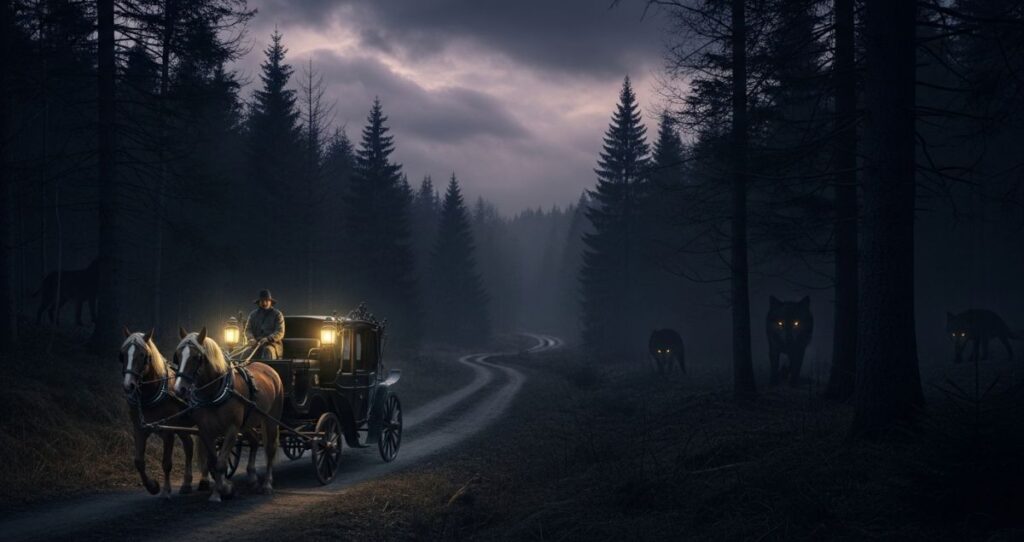
Our journey begins with a young solicitor named Jonathan Harker travelling east from the familiar bustle of London into the widening quiet of the Carpathian foothills. The train and the road slow, the villages change, and every smell and sound feels like a step into another world — the sharp scent of wood smoke, the fertility of wet earth, and the faint, unsettling metallic tang of old mountain air that speaks of storms and ages past. He notes the strange, colourful clothes of the peasants, the crucifixes and shrines at every wayside, and the heavy, superstitious silence that gathers about certain places like an impenetrable fog.
Explore More Classic Adaptations: If you enjoy atmospheric horror, you might also like our retelling of The Shadow Over Innsmouth , another tale of creeping dread and ancient evils.
Even before he reaches his destination, a profound sense grows within him that he is being led not just to a place, but back in time, toward traditions that will not deign to speak to a hurried, modern mind.
At Bistritz, the hotel is old and crowded with people who cross themselves and whisper fervently as Jonathan prepares to continue his journey by coach. An anxious, motherly woman presses a rosary of wooden beads into his hands and begs him to delay, her voice a frantic whisper warning him, in a mixture of German and Romanian, about the terrible danger of venturing out on the eve of St. George’s Day, when the night is known to be alive with every evil thing in the world. He is polite, practical, and dismissive; a child of an age that believes in progress and the certainty of railway timetables. Despite the chill that now persistently creeps up his spine, he takes his seat.
As the road narrows into the dark, forbidding Borgo Pass, an odd, urgent haste grips the coach and its passengers. The horses strain against their traces, the driver lashes them with a desperate frenzy, and then, from the swirling darkness behind them, a strange, silent calèche appears, overtaking them with an unnerving speed. Its driver is a mere shadow on the box, a figure with bright, unsettling eyes that seem to gleam in the lamplight and a deep, resonant laugh that seems to vibrate not in the ears, but against the very bones.
The Ancient Prison
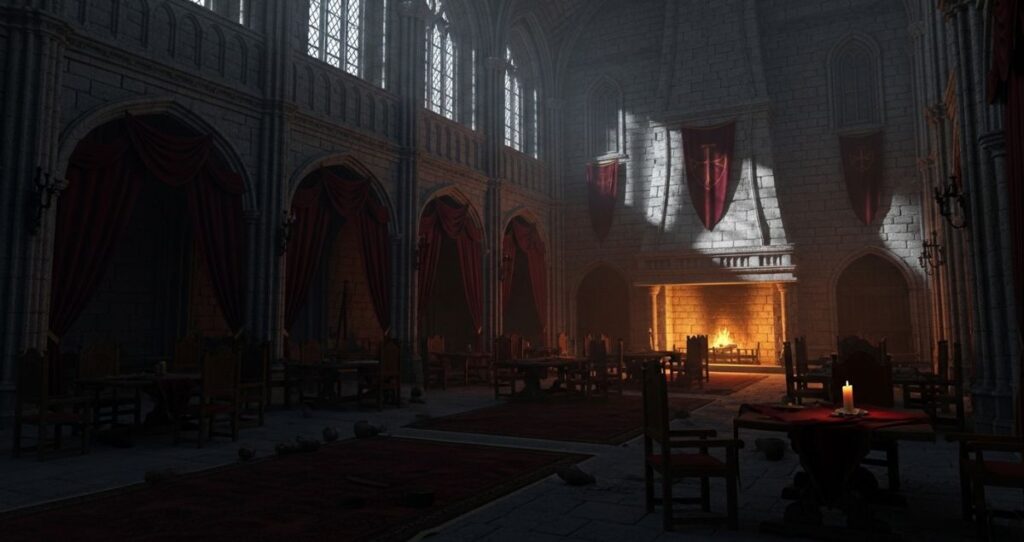
They arrive at a ruined castle, set high and formidable against the star-scattered sky, a place of immense, cold stones and massive, iron-studded doors. Jonathan is received by a polite, courtly old man who calls himself Count Dracula. His manners are exquisitely old-fashioned, yet his presence carries an unnatural chill. The Count insists on personally carrying Jonathan’s luggage, a feat of surprising strength, and ushers him through long, echoing stone passages into rooms rich with ancient tapestries.
By daylight, the castle reveals its magnificent library, stocked not with musty old tomes, but with English books, directories, and guides—a careful, meticulous preparation for a guest expected to help a nobleman navigate the complex world of modern London. But Jonathan cannot help but notice physical features that deeply unsettle him: a strange, corpse-like pallor, hair growing in the centre of his palms, teeth that gleam too sharply, and breath that is rank with a strange, earthy odour.
As the days pass, the castle settles into a strange, unnerving pattern: rooms to be explored that lead only to locked doors, a schedule that keeps the Count strangely absent for long afternoons. He catches glimpses of pale, beautiful women gliding through the moonlit corridors, their voices seductive and terrifying. The old superstitions Jonathan half-dismissed in the daylight gather crushing weight as the shadows lengthen.
A Tale of Heartbreak and Beauty: For a change of pace from horror, discover our collection of poignant stories in The Happy Prince and Other Tales .
When the Count’s immediate business is finished, there is a sudden, frantic urgency to arrange for a shipment of fifty large, wooden boxes—strange earth-filled coffins—to be sent to England. Jonathan escapes physically, but a deeper, psychological unease stays with him—a collection of terrifying images that will return to haunt his dreams.
The Shadow on the Shore
Meanwhile, across the sea in the picturesque coastal village of Whitby, strange things begin to happen. A violent, unnatural storm tears a Russian schooner, the Demeter, to pieces on the harbour shore. The only thing found aboard is the dead captain, lashed to the wheel, and a single, large, mysterious box of foul earth. Lucy, young, kind, and recently engaged, begins to suffer from a strange, debilitating weakness and recounts dreamlike visits to the cemetery, where she feels a dark presence looming over her.
Lucy’s health declines with an alarming rapidity that baffles the finest doctors. Dr. Seward summons his old teacher, Professor Abraham Van Helsing from Amsterdam. Van Helsing is a learned and supremely practical man, yet he also possesses a deep knowledge of folk medicine and superstition. He examines the two tiny, unexplained puncture wounds on Lucy’s throat and begins to arrange a protective barrier of garlic flowers around her bed.
The Un-Dead
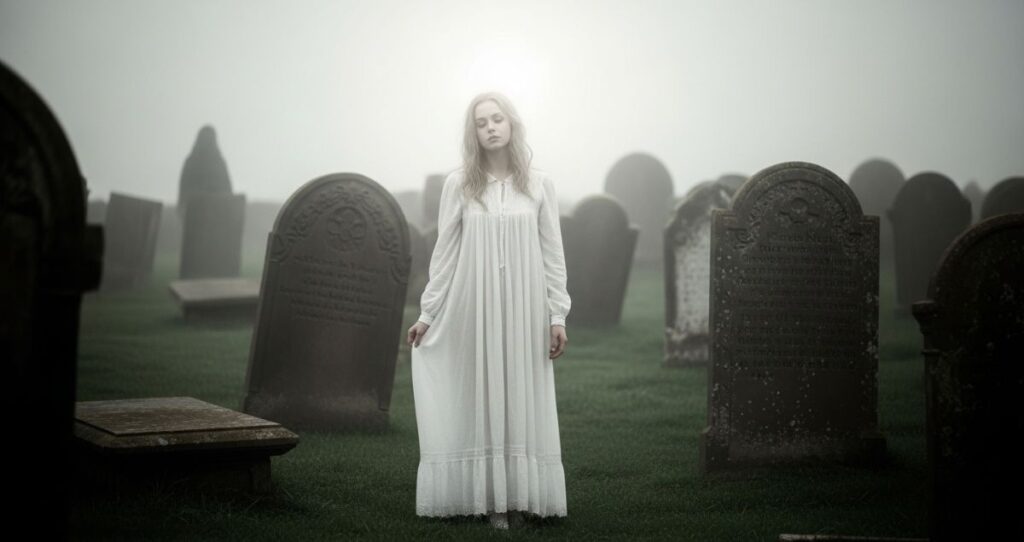
But their protections are not enough. As Lucy grows ever thinner, she is visited at night by a figure that drains her very life force. Mina, faithful and practical, arrives to help nurse her friend. The group—Jonathan, Mina, Van Helsing, Dr. Seward, Lucy’s fiancé Arthur, and the brave American Quincey Morris—begin to suspect a truth so terrible it threatens to shatter their sanity: something ancient and monstrous has come ashore in modern England.
One moonlit night, in the hush of the old churchyard, the thing that has been haunting Lucy is finally revealed. They find her as one of the Un-Dead—a beautiful, pale revenant who now moves among the children of Whitby. In a small, brutally bright act of love and courage, they perform what must be done: to free her immortal soul. They have won a battle, but the war for their very souls is just beginning.
Facing the Darkness Within: The theme of confronting hidden evils is central to our story The Monster in the Mirror , which explores the shadows that lurk not in castles, but in the human heart.
The Hunters and the Hunted
The group traces the movement of the fifty boxes of earth across London. They discover the Count’s cunning strategy: establishing multiple refuges, each containing the sacred soil of his homeland. They begin a methodical cleansing, destroying each lair during the daylight.
Mina becomes the centre that holds their desperate efforts steady. Then, their worst fears are realized. The Count, in a rage, breaks into their room and forces Mina to drink his own blood—creating a terrible bond between them. The stakes of their hunt are instantly transformed. The issue is now about a woman they all love, whose very soul bears the stain of assault.
Van Helsing teaches them the old, immutable rules of the thing that walks in the night. It is repelled by symbols of faith and vulnerable to sunlight. Their experiments become a blend of scientific method and grim folklore.
Further Reading on Classic Horror: For those interested in the roots of cosmic horror, The H.P. Lovecraft Archive offers extensive resources on the genre. Additionally, Bram Stoker Online provides access to the author’s original works and manuscripts.
The Final Pursuit
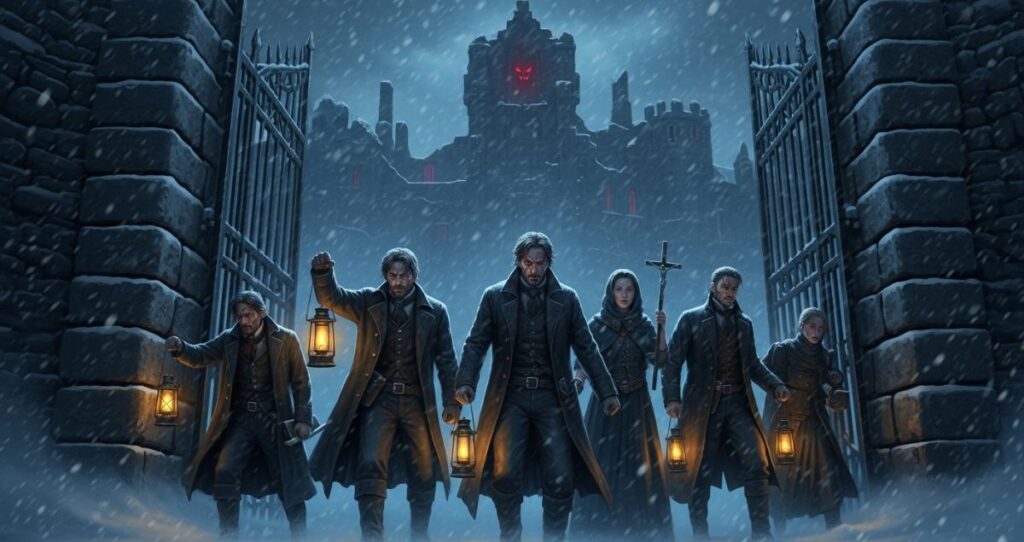
The hunt becomes a desperate map across vast landscapes: trains and steamers, quiet river towns, and finally, along the Danube, where the Count has fled back toward his ancient home. Mina, through her bond, guides them even as the connection drains her.
In the wild Carpathian heights, the weather turns against them. At night, the Count’s castle looms above them like a terrifying memory made of stone. They bring crucifixes, holy wafers, and profound faith.
The final pursuit becomes intimate and urgent. The Count flees with desperation. At dawn, in a high courtyard, they come together for the final effort. All the ancient rules and steadfast faith converge in a terrible, choreographed assault.
The End and The Beginning

The decisive moment arrives—a clean cut between life and a fate worse than death. Jonathan’s knife and Quincey’s blade strike true. The Count’s body crumbles to dust. Mina begins to mend.
In the months that follow, the group rebuilds their lives around simple, precious routines. They keep their records as a sacred duty, to guard against forgetting.
There is a profound sense that the brave and the gentle have preserved a fragile human order. The story closes not with a boastful triumph, but with a quiet record—a plea that we remember how easily the shadows can descend.
Why This Adaptation Matters
This Bram Stoker Dracula adaptation preserves the novel’s emotional depth while offering clearer, more immediate language for the modern reader. The textures of this world—the cold stones, the whispering pines, the crash of the Whitby storm, and the small, brave voices of ordinary people—stay with you long after you have finished reading.
Explore the Classics: For more timeless tales, visit Project Gutenberg, where you can find thousands of free classic novels, including the original Dracula.