
The Happy Prince and Other Tales by Oscar Wilde is a collection of timeless fairy tales that continue to touch hearts across generations. Before we dive into these beautiful stories, please let me know in the comments where you’re reading from today. I love knowing where my readers are joining me from.
The Happy Prince: Oscar Wilde’s Most Beloved Tale
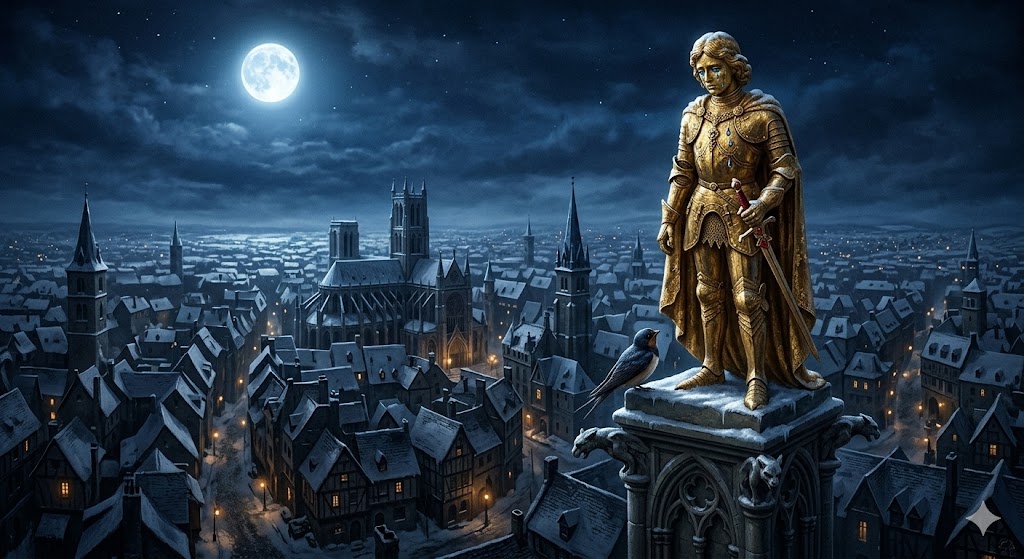
High above the city, mounted upon a tall stone column, stood the statue of The Happy Prince. He was covered entirely in delicate leaves of fine gold. For eyes, he possessed two brilliant sapphires that caught the light, and a large, glowing red ruby was set into the hilt of his sword.
The people of the city admired him greatly. One of the Town Councillors, who wished to be thought of as a man of artistic taste, remarked, “He is as beautiful as a weathercock.” Then, fearing he might seem impractical, he quickly added, “Though not nearly as useful, of course.”
A sensible mother, trying to quiet her little boy who was crying for the moon, would say, “Why can’t you be like the Happy Prince? He never dreams of crying for anything he doesn’t have.” And a disappointed man, gazing up at the splendid statue, would mutter to himself, “At least there is someone in this world who is truly happy.”
One chill evening, as autumn was tightening its grip, a little Swallow flew over the city. His friends had departed for the warm skies of Egypt six weeks earlier, but he had stayed behind. He had been in love with a beautiful Reed he met by the river in the spring, captivated by her slender waist. All through the summer, he had flown around her, touching the water with his wings to create silver ripples in a charming courtship.
But the other Swallows had twittered that it was a ridiculous attachment. “She has no money, and far too many relatives,” they said before flying south. Now alone, the Swallow began to tire of his lady-love. “She has no conversation,” he complained to the empty air. “And I’m afraid she’s a coquette, always flirting with the wind.” When he asked her to come away with him to the pyramids, she simply shook her head, too attached to her home.
“You have been trifling with me!” he cried, his heart feeling both hurt and relieved. “I am off to Egypt. Goodbye!” And he flew away, traveling all day until he reached the great city at nightfall.
Looking for a place to rest, he saw the statue on the tall column. “I will put up there,” he declared. “It’s a fine position with plenty of fresh air.” He alighted gently between the feet of the golden Prince, pleased with his golden bedroom. But just as he tucked his head under his wing, a large, heavy drop of water fell on him.
“How curious,” he said, looking at the clear, starry sky. “It isn’t raining.” Then another drop fell. “What is the use of a statue if it cannot keep the rain off?” he muttered, preparing to fly away. But before he could open his wings, a third drop fell. He looked up, and his breath caught in his throat.
The eyes of the Happy Prince were filled with tears, which were streaming down his golden cheeks. In the cool moonlight, his face was so beautiful and so sorrowful that the little Swallow’s heart swelled with pity.
“Who are you?” the Swallow asked softly.
“I am the Happy Prince,” the statue replied, its voice low and musical.
“Then why are you weeping? You have quite drenched me,” said the Swallow.
“When I was alive and had a human heart,” answered the statue, “I did not know what tears were. I lived in the Palace of Sans-Souci, where sorrow was never allowed to enter. I played in the sunlit gardens by day and led the dance in the Great Hall by night. A high wall surrounded the garden, and I never cared to ask what lay beyond it. Everything about me was beautiful. My courtiers called me the Happy Prince, and indeed I was happy, if pleasure is the same as happiness. So I lived, and so I died.”
The statue paused, a sigh seeming to whisper through its golden form. “Now that I am dead, they have set me up here so high that I can see all the ugliness and all the misery of my city. And though my heart is now made of lead, I cannot choose but weep.”
The First Sacrifice
Far away, the Prince explained, in a narrow little street, there was a poor house. Through an open window, he could see a woman seated at a table. Her face was thin and worn, and her hands were coarse and red, pricked all over by her needle, for she was a seamstress. She was embroidering passion-flowers onto a satin gown for the loveliest of the Queen’s maids-of-honour to wear at the next Court-ball.
In a bed in the corner of the room, her little boy lay ill with fever, crying out for oranges. His mother had nothing to give him but river water. “Swallow, Swallow, little Swallow,” said the Prince, “will you not bring her the ruby from my sword-hilt? My feet are fastened to this pedestal and I cannot move.”
“My friends are waiting for me in Egypt,” the Swallow replied. “They are flying up and down the Nile, talking to the great lotus-flowers.” But the Happy Prince looked so sad, and the thought of the thirsty boy and the weary mother pulled at the bird’s spirit. The night air was growing bitterly cold. “I will stay with you for one night,” the Swallow said finally, “and be your messenger.”
With care, the Swallow picked out the great ruby from the Prince’s sword. It was heavy and warm in his beak. He flew over the sleeping city, past the cathedral tower where white marble angels stood frozen in prayer. He heard the sound of dancing from the palace and saw a beautiful girl on a balcony with her lover, speaking of stars and love.
He flew over the river, where lanterns swung from the masts of ships like captive fireflies. At last, he came to the poor house and peered inside. The boy was tossing feverishly, and his mother had fallen asleep at the table, exhausted. The Swallow hopped in and laid the great ruby beside the woman’s thimble. Then he flew gently around the bed, fanning the boy’s forehead with his cool wings. “How nice and cool I feel,” murmured the boy, slipping into a peaceful sleep.
Returning to the Prince, the Swallow felt an unexpected warmth in his own small body. “That is because you have done a good action,” said the Prince. Content, the Swallow slept at the Prince’s feet.
The Second Sacrifice
The next day brought more requests from the Prince, who could now see more suffering with his sapphire eyes. He asked the Swallow to pluck out one of those precious eyes and take it to a young student in a garret, who was too cold and hungry to finish writing a play. The Swallow wept at the thought, but the Prince commanded him. “Do as I ask you.”
With great sorrow, the Swallow plucked out the sapphire eye and carried it through a hole in the student’s roof. He found the young man with his head in his hands, surrounded by papers, a bunch of withered violets in a glass beside him. The Swallow left the jewel on the dried flowers and slipped away. The student looked up, amazed. “I am beginning to be appreciated!” he cried, his despair turning to joy. “Now I can finish my play!”
But the Prince’s compassion was not yet spent. He told the Swallow of a little match-girl in the square below, who had let her matches fall into the gutter. She had no shoes or stockings, and if she went home with no money, her father would beat her. “Pluck out my other eye,” the Prince said, “and give it to her.”
“Dear Prince,” the Swallow protested, “I cannot leave you blind.”
“Swallow, Swallow, little Swallow,” came the gentle, insistent voice. “Do as I command you.”
So the Swallow took the Prince’s last eye, and as he swooped past the shivering girl, he slipped the jewel into her hand. “What a lovely bit of glass!” she exclaimed, laughing as she ran home, her troubles forgotten.
Returning to the column, the Swallow made a decision. “You are blind now,” he said. “So I will stay with you always.” And he slept at the Prince’s feet.
The Final Gift
All through the next day, he sat on the Prince’s shoulder, telling him stories of the strange lands he had seen: of red ibises fishing in the Nile, of the ancient Sphinx in the desert, of merchants with amber beads walking beside their camels. The Prince listened, but his thoughts were elsewhere. “Dear little Swallow,” he said, “you tell me of marvellous things, but more marvellous than anything is the suffering of men and women. There is no Mystery so great as Misery. Fly over my city once more, and tell me what you see.”
The Swallow flew out over the great, sprawling city. He saw the rich making merry in their warm, beautiful houses while beggars sat starving at their gates. He flew into dark lanes and saw the white, listless faces of hungry children. Under the archway of a bridge, two little boys were huddled together for warmth. “How hungry we are!” they said, before a Watchman shouted at them to move on into the cold rain.
When the Swallow reported all this, the Prince spoke his final request. “I am covered with fine gold. You must take it off, leaf by leaf, and give it to my poor. The living always think that gold can make them happy.”
So the loyal Swallow picked off leaf after leaf of the fine gold, carrying each piece to the poor of the city. The children’s faces grew rosier, and they laughed and played in the streets once more, crying, “We have bread now!” The Happy Prince, stripped of his dazzling covering, looked dull and grey, like common stone.
The End of the Journey
Winter descended in full force. Snow fell, and then a hard, biting frost. The streets shone like silver, and icicles hung like crystal daggers from the eaves. The poor little Swallow grew colder and colder, but he would not leave the Prince. He loved him too well. He picked up crumbs where he could and flapped his wings to keep warm, but his strength was failing.
He knew he was dying. With his last bit of strength, he flew up to the Prince’s shoulder. “Goodbye, dear Prince,” he whispered. “May I kiss your hand?”
“I am glad you are going to Egypt at last, little Swallow,” said the Prince. “You have stayed too long here. But you must kiss me on the lips, for I love you.”
“It is not to Egypt that I am going,” said the Swallow. “I am going to the House of Death.” And he kissed the Happy Prince on his cold lips, then fell down dead at his feet.
At that very moment, a curious crack sounded inside the statue, as if something had broken. The leaden heart had snapped right in two.
The next morning, the Mayor was walking in the square below with the Town Councillors. He looked up and frowned. “Dear me! How shabby the Happy Prince looks!” he said. The Councillors, who always agreed with the Mayor, echoed his sentiment. “The ruby has fallen from his sword, his eyes are gone, and he is golden no longer,” declared the Mayor. “He is little better than a beggar!”
Noticing the dead bird at the statue’s base, the Mayor ordered the statue pulled down. “As he is no longer beautiful, he is no longer useful,” said the Art Professor at the University.
They melted the statue in a furnace. The Mayor held a meeting to decide what to do with the metal, suggesting a statue of himself—a notion that started a quarrel among the Councillors that, it was said, continued for a very long time.
At the foundry, the overseer of the workmen found something curious. “This broken lead heart will not melt,” he said. “We must throw it away.” So they threw it onto a dust-heap where the dead Swallow also lay.
In a place beyond places, God spoke to one of His Angels. “Bring me the two most precious things in the city.” The Angel brought Him the leaden heart and the dead bird.
“You have chosen rightly,” said God. “For in my garden of Paradise, this little bird shall sing for evermore, and in my city of gold, the Happy Prince shall praise me.”
The Nightingale and the Rose
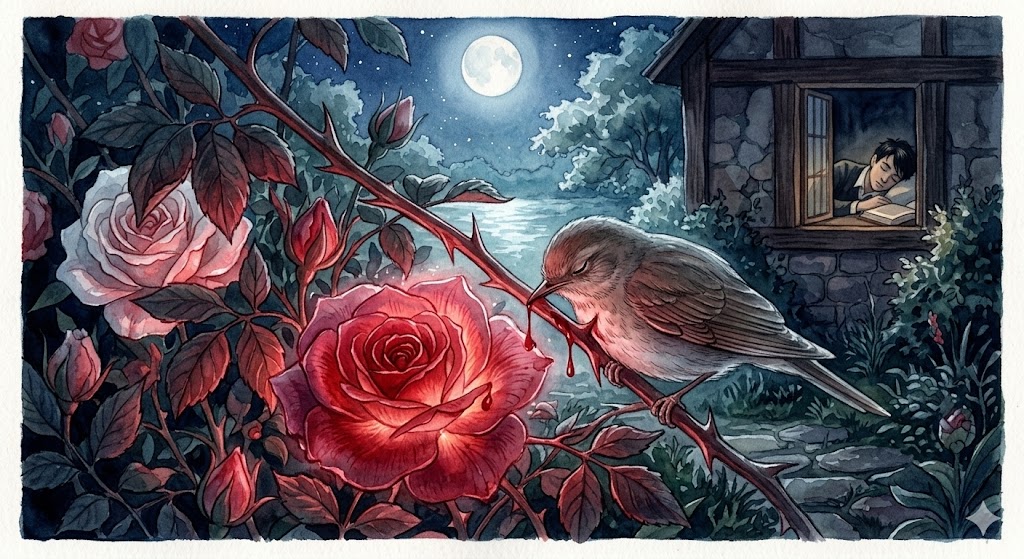
“She said that she would dance with me if I brought her red roses,” cried the young Student, his voice thick with despair. “But in all my garden, there is not a single red rose.”
From her nest in the old holm-oak tree, the Nightingale heard him. She peered out through the dense leaves, her heart touched by the anguish in his voice. “Here at last is a true lover,” she thought. She had sung of love night after night, though she had never known it, telling its story to the stars. Now she saw him: his hair as dark as hyacinth, his lips as red as the rose he desired, but his face was pale as ivory from passion, and sorrow had marked his brow.
The Student sank to the grass, burying his face in his hands. “The Prince gives a ball tomorrow night, and my love will be there. If I bring her a red rose, I shall hold her in my arms, and she will lean her head upon my shoulder. But without it, she will pass me by, and my heart will break.”
The Nightingale understood the secret of his sorrow. “What I sing of, he suffers,” she murmured to herself. “Love is more precious than emeralds, dearer than fine opals. It cannot be bought or sold.”
The Search for the Red Rose
Determined to help, she spread her brown wings and soared from the oak, sailing like a shadow across the garden. In the centre of a grass-plot stood a beautiful Rose-tree. She lit upon a spray and cried, “Give me a red rose, and I will sing you my sweetest song.”
But the Tree shook its head. “My roses are white,” it answered, “white as sea-foam, whiter than mountain snow. Go to my brother who grows round the old sun-dial. Perhaps he can help.”
The Nightingale flew to the Rose-tree by the sun-dial and made the same request. But this Tree, too, shook its head. “My roses are yellow,” it said, “as yellow as a mermaid’s hair. Go to my brother who grows beneath the Student’s window.”
Filled with hope, she flew to the tree beneath the Student’s window. “Give me a red rose,” she pleaded once more.
“My roses are red,” answered the Tree. “As red as the feet of a dove, redder than coral fans in ocean caverns. But the winter has chilled my veins, the frost has nipped my buds, and the storm has broken my branches. I shall have no roses at all this year.”
The Nightingale’s heart sank. “Is there no way?” she whispered. “Only one red rose—that is all I need.”
The Tree was silent for a long moment. “There is a way,” it said finally, its voice grave. “But it is so terrible I dare not tell you.”
“Tell me,” said the Nightingale. “I am not afraid.”
The Price of Love
“If you want a red rose,” said the Tree, “you must build it out of music by moonlight. You must sing to me with your breast pressed against a thorn. All night long you must sing, and the thorn must pierce your heart. Your life-blood must flow into my veins and become mine.”
The Nightingale drew back. “Death is a great price to pay for a red rose,” she said. “Life is very dear. It is pleasant to sit in the green wood and watch the sun and moon travel the sky. The scent of hawthorn is sweet, and the bluebells in the valley are lovely. Yet…” She thought of the Student’s tear-filled eyes. “Yet Love is better than Life. And what is the heart of a bird compared to the heart of a man?”
She flew back to the Student, who still lay weeping on the grass. “Be happy,” she cried to him. “You shall have your red rose. I will build it out of music by moonlight, and stain it with my own heart’s-blood. All I ask in return is that you will be a true lover.”
The Student looked up, but he did not understand her language. He only knew the things written in books. The Oak-tree, however, understood and felt a deep sadness, for he was fond of the little Nightingale. “Sing me one last song,” he whispered. “I shall be lonely when you are gone.”
So the Nightingale sang to the Oak, her voice like clear water bubbling from a silver jar. When she finished, the Student got up, pulled out a notebook, and muttered to himself as he walked away. “She has form, but has she got feeling? I am afraid not. She is like most artists—all style, no sincerity. What a pity her beautiful notes mean nothing.”
The Sacrifice
That night, when the moon rose like a great pearl in the heavens, the Nightingale flew to the Rose-tree. She set her breast against the longest, sharpest thorn. Then, taking a deep breath, she began to sing.
She sang first of the birth of love in the heart of a boy and a girl. As she sang, a marvellous rose began to blossom on the topmost spray of the Tree, petal following petal. It was pale at first, pale as the morning mist, silver as the wings of dawn.
“Press closer, little Nightingale,” cried the Tree. “Or the Day will come before the rose is finished.”
The Nightingale pressed closer, and the thorn bit deeper. She sang louder now, of the birth of passion in the soul of a man and a maid. A delicate flush of pink came into the rose’s leaves, like the blush in a bridegroom’s face.
But the thorn had not yet reached her heart, so the rose’s heart remained white. “Press closer,” the Tree urged again. The Nightingale pressed closer still. The thorn touched her heart, and a fierce, searing pain shot through her. Wilder and wilder grew her song, for she sang of the Love that is perfected by Death, the Love that does not die.
The marvellous rose became a deep, rich crimson, like the sky at dawn. Crimson were its petals, and crimson as a ruby was its heart.
The Nightingale’s voice grew faint. Her little wings fluttered weakly, and a film came over her eyes. She gave one last, burst of music. The white Moon heard it and lingered in the sky. The red rose trembled with ecstasy and opened its petals to the cold morning air.
“Look, look!” cried the Tree. “The rose is finished now!” But the Nightingale made no answer. She was lying in the long grass, the thorn in her heart, her song silenced forever.
The Waste of a Sacrifice
At noon, the Student opened his window. “Why, what a wonderful piece of luck!” he exclaimed. “Here is a red rose! I have never seen one like it in all my life.” He leaned out, plucked it, and hurried to the Professor’s house, where the girl he loved sat in the doorway winding blue silk.
“You said you would dance with me if I brought you a red rose,” he cried triumphantly. “Here is the reddest rose in all the world!”
The girl frowned. “I am afraid it will not go with my dress,” she said coolly. “Besides, the Chamberlain’s nephew has sent me real jewels, and everyone knows jewels cost far more than flowers.”
Stung, the Student threw the rose into the street, where it fell into the gutter and was crushed by a cart-wheel. “What a silly thing Love is,” he said bitterly as he walked away. “It is not half as useful as Logic. It does not prove anything. I shall go back to Philosophy and study Metaphysics.” And he returned to his room and a great dusty book, leaving the nightingale’s sacrifice forgotten in the mud.
The Selfish Giant
Every afternoon, after school, the children would run to play in the Giant’s garden. It was a large, lovely place with soft green grass. Here and there, beautiful flowers bloomed like stars, and there were twelve peach trees that in spring broke into delicate blossoms of pink and pearl, and in autumn bore rich, sweet fruit. The birds sat in the trees and sang so sweetly the children would stop their games just to listen. “How happy we are here!” they would cry to each other.
But one day, the Giant came home. He had been visiting his friend, the Cornish ogre, for seven years. When he arrived, he saw the children playing in his garden. “What are you doing here?” he roared in a voice as gruff as thunder. The children, terrified, scattered and ran away.
“My own garden is my own garden,” the Giant declared. “Any one can understand that. I will allow nobody to play in it but myself.” And he built a high wall all around it, and put up a notice-board that read: TRESPASSERS WILL BE PROSECUTED. He was a very selfish Giant.
The poor children had nowhere to play. They tried the dusty, stony road, but it was no good. They would wander around the high wall when lessons were over, talking wistfully about the beautiful garden inside. “How happy we were there,” they would sigh.
The Eternal Winter
Then Spring came. All over the country, little blossoms opened, and little birds sang. But in the garden of The Selfish Giant, it remained Winter. The birds did not care to sing where there were no children, and the trees forgot to blossom. Once, a beautiful flower pushed its head through the grass, but when it saw the notice-board, it felt so sorry for the children that it slipped back into the ground and went to sleep.
The only ones pleased were the Snow and the Frost. “Spring has forgotten this garden,” they cried gleefully. “So we will live here all year round.” The Snow covered the grass with her great white cloak, and the Frost painted all the trees silver. Then they invited the North Wind to stay. He came, wrapped in furs, and roared all day about the garden, blowing the chimney-pots down. “This is a delightful spot,” he bellowed. “We must ask the Hail on a visit.”
So the Hail came. For three hours every day, he rattled on the castle roof till he broke most of the slates, then ran round and round the garden as fast as he could go. He was dressed in grey, and his breath was like ice.
The Giant sat at his window, looking out at his cold, white, silent garden. “I cannot understand why the Spring is so late in coming,” he muttered. But the Spring never came, nor the Summer. The Autumn gave golden fruit to every other garden, but to the Giant’s garden she gave none. “He is too selfish,” she said. So it was always Winter there, and the North Wind, the Hail, the Frost, and the Snow danced through the barren trees.
The Awakening
One morning, the Giant was lying awake in bed when he heard the most beautiful music. It sounded so sweet to his ears that he thought it must be the King’s musicians passing by. It was, in fact, a little linnet singing outside his window. It had been so long since he had heard a bird sing in his garden that it seemed the most beautiful music in the world. Then the Hail stopped dancing, and the North Wind ceased roaring. A delicious, warm perfume drifted through the open casement.
“I believe the Spring has come at last,” said the Giant. He jumped out of bed and looked out.
What he saw was a most wonderful sight. Through a little hole in the wall, the children had crept in. They were sitting in the branches of the trees. In every tree he could see, there was a little child. And the trees were so glad to have the children back that they had covered themselves with blossoms and were waving their branches gently above the children’s heads. The birds were flying about, twittering with delight, and the flowers were peeking up through the green grass and laughing. It was a lovely scene.
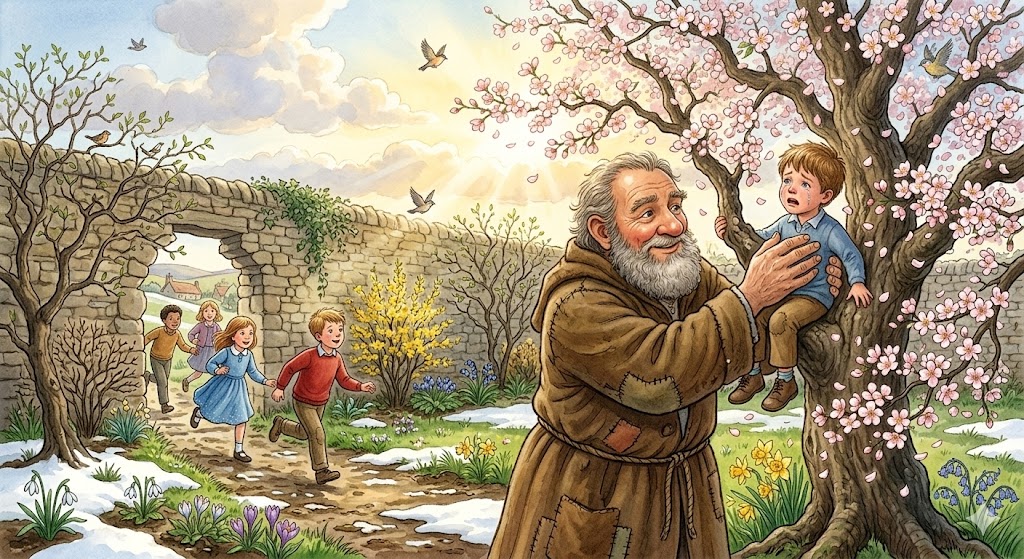
Only in the farthest corner of the garden was it still Winter. There, a little boy stood, too small to reach the branches of the tree. He was wandering all around it, crying bitterly. The poor tree was still covered with frost and snow, and the North Wind blew above it. “Climb up, little boy,” the Tree whispered, bending its branches down as low as it could. But the boy was too tiny.
The Giant’s heart, which had been as cold as the garden, melted as he looked out. “How selfish I have been!” he said, a great wave of shame washing over him. “Now I know why the Spring would not come here. I will put that poor little boy in the tree, and then I will knock down the wall, and my garden shall be the children’s playground forever.”
The Transformation
He crept downstairs, his great feet silent on the stones, and opened the front door softly. But when the children saw him, they were so frightened they all ran away, and the garden became Winter again in an instant. Only the little boy did not run, for his eyes were so full of tears he did not see the Giant coming.
The Giant stole up behind him, took him gently in his enormous hand, and placed him high in the tree. At once, the tree broke into blossom, the birds came and sang, and the little boy stretched out his arms, flung them around the Giant’s neck, and kissed him.
When the other children saw the Giant was not wicked, they came running back, and with them came the Spring. “It is your garden now, little children,” said the Giant, his voice thick with emotion. He took a great axe and knocked down the wall. From that day on, the children played in the garden every afternoon, and the Giant played with them.
But the little boy he had helped—the one who had kissed him—never came again. The Giant loved him best and often asked about him. “How I would like to see him,” he would say, a touch of loneliness in his voice.
The Final Meeting
Years passed, and the Giant grew very old and feeble. He could no longer play, so he sat in a huge armchair, watching the children at their games and admiring his garden. “I have many beautiful flowers,” he would say, “but the children are the most beautiful flowers of all.”
One winter morning, as he was dressing, he looked out his window. He did not hate Winter now, for he knew it was merely Spring asleep. Suddenly, he rubbed his eyes in wonder. In the farthest corner of the garden stood a tree covered with lovely white blossoms. Its branches were golden, and silver fruit hung from them. Underneath it stood the little boy he had loved.
Filled with joy, the Giant rushed downstairs and out into the garden. He hastened across the grass. But when he came near the child, his face grew red with anger. On the palms of the child’s hands were the prints of two nails, and the same prints were on his little feet.
“Who hath dared to wound thee?” cried the Giant, his old voice trembling with fury. “Tell me, that I may take my big sword and slay him!”
“Nay,” answered the child, his voice gentle and full of a peace that filled the garden. “These are the wounds of Love.”
“Who art thou?” whispered the Giant, and a strange awe fell upon him. He knelt before the little child.
The child smiled. “You let me play once in your garden. Today, you shall come with me to my garden, which is Paradise.”
And when the children ran into the garden that afternoon, they found the Giant lying dead under the tree, all covered with white blossoms, a smile of perfect peace upon his old face.
The Devoted Friend
One morning, an old Water-rat popped his head out of his hole. He had bright, beady eyes and stiff grey whiskers, and his tail was like a long bit of black india-rubber. Nearby, some little yellow ducks were swimming in the pond, and their mother, who was pure white with red legs, was trying to teach them how to stand on their heads in the water.
“You will never be in the best society unless you can stand on your heads,” she kept saying. But the little ducks paid no attention. They were too young to care about society.
“What disobedient children!” sniffed the Water-rat. “They really deserve to be drowned.”
“Every one must make a beginning,” answered the Duck patiently, before swimming away to give her children a good example by standing on her own head.
The Water-rat puffed out his chest. “I know nothing about the feelings of parents,” he declared. “I am not a family man. Love is all very well, but friendship is much higher. Indeed, I know of nothing in the world nobler or rarer than a devoted friendship.”
A Green Linnet, sitting in a willow-tree, overheard this. “And what, pray, is your idea of the duties of a devoted friend?” he asked.
The Water-rat looked offended. “I should expect my devoted friend to be devoted to me, of course.”
“And what would you do in return?” chirped the Linnet.
“I don’t understand you,” said the Water-rat, confused. So the Linnet offered to tell him a story on the subject, a story applicable to him. The Water-rat, who was extremely fond of fiction, agreed.
Little Hans and the Miller
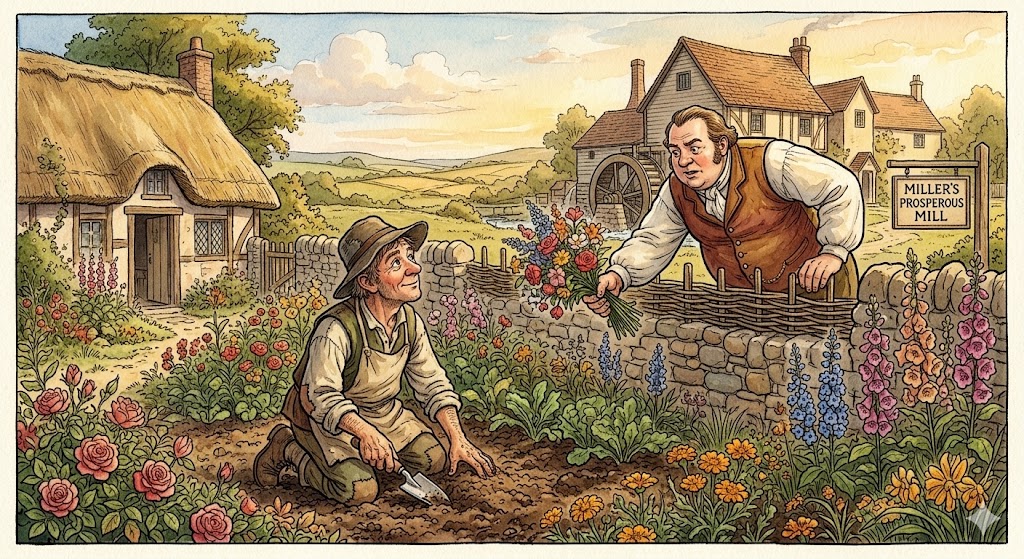
“Once upon a time,” began the Linnet, “there was an honest little fellow named Hans.” Hans was not distinguished, except for his kind heart and his funny, round, good-humoured face. He lived alone in a tiny cottage and worked every day in his garden, which was the loveliest in all the country-side, full of sweet-williams, gilly-flowers, damask roses, violets, and every flower that bloomed in its season.
Hans had many friends, but his most devoted friend was big Hugh the Miller. So devoted was the rich Miller that he would never go by Hans’s garden without leaning over the wall to pluck a large nosegay, or fill his pockets with fruit in season. “Real friends should have everything in common,” the Miller used to say, and little Hans, nodding and smiling, felt proud to have a friend with such noble ideas.
It was true the Miller never gave Hans anything in return, though he had a hundred sacks of flour, six milch cows, and a large flock of sheep. But Hans never troubled his head about it. Nothing gave him greater pleasure than to listen to the Miller’s wonderful speeches about the unselfishness of true friendship.
So little Hans worked away. In spring, summer, and autumn, he was happy. But in winter, with no flowers or fruit to sell, he suffered from cold and hunger, often going to bed with only a few dried pears for supper. He was also extremely lonely, for the Miller never came to see him then.
“There is no good in my going to see little Hans in winter,” the Miller would say to his wife by their cozy fire. “When people are in trouble, they should be left alone. That is my idea of friendship. I shall wait till spring, and then he can give me a large basket of primroses, which will make him so happy.”
His wife thought him very thoughtful. Even their youngest son suggested inviting Hans to share their warmth and food, but the Miller scolded him. “If Hans saw our warm fire and good supper, he might get envious, and envy would spoil his nature. I am his best friend, and I must watch over him. Besides, he might ask me for flour on credit, and flour is one thing, friendship is another.”
The Promised Wheelbarrow
When spring came, the Miller went down to see Hans with a big basket. “Good morning, little Hans!” he boomed. Hans, leaning on his spade, smiled from ear to ear. The Miller asked about his winter, and Hans admitted it had been hard. “But now the spring has come, and I am quite happy,” he said. “I am going to sell my primroses at the market and buy back my wheelbarrow.”
“Buy back your wheelbarrow? You don’t mean you sold it? What a stupid thing to do!”
Hans explained that winter had been so bad he’d had to sell his silver buttons, his silver chain, his big pipe, and finally his wheelbarrow to buy food. “But I am going to buy them all back now,” he said cheerfully.
The Miller placed a heavy hand on Hans’s shoulder. “Hans, I will give you my wheelbarrow. It is not in very good repair—one side is gone, and the wheel-spokes are wonky—but I will give it to you. I know it is generous. I have a new one for myself. But, since I am giving you my wheelbarrow, you should give me your plank of wood in return. I need it to mend a hole in my barn roof.”
Hans readily agreed, though the plank was the very one he needed to repair the wheelbarrow. The Miller then asked Hans to fill his big basket with flowers. Hans hesitated, for if he filled the huge basket, he would have none left to sell to buy back his silver buttons. But the Miller said, “True friendship is quite free from selfishness.” So Hans plucked all his pretty primroses until the basket was full.
The Never-Ending Favours
The pattern continued. The next day, the Miller asked Hans to carry a sack of flour to market for him. Hans was busy watering flowers and nailing creepers, but the Miller said, “Considering I am going to give you my wheelbarrow, it is rather unfriendly of you to refuse.” So Hans trudged for miles under the hot sun with the heavy sack.
The day after that, the Miller asked Hans to mend his barn roof. Hans was anxious to work in his own garden, but again, the appeal to friendship worked. He spent all day on the barn. The Miller praised him: “There is no work so delightful as the work one does for others.” Then he asked Hans to drive his sheep to the mountain the next day.
This went on all through the spring and summer. Hans’s garden began to suffer, for he was always running errands or helping at the mill. But he consoled himself by thinking of the promised wheelbarrow and reading over the beautiful things about friendship the Miller had said, which Hans had written down in a notebook.
The Final Errand
One wild, stormy night, there came a loud rap at Hans’s door. It was the Miller with a lantern and a big stick. “My little boy has fallen off a ladder and hurt himself,” he cried. “I need you to go for the Doctor. He lives far away, and it’s such a bad night. Since I am going to give you my wheelbarrow, it’s only fair you do this for me.”
Hans agreed at once but asked to borrow the lantern. “Oh, I’m sorry,” said the Miller. “It’s my new lantern. It would be a great loss if anything happened to it.” So Hans set off into the dreadful storm without a light. The night was black, the wind ferocious. After walking for hours, he found the Doctor and brought him back toward the Miller’s house. But on the moor, in the blinding rain, poor little Hans lost his way and fell into a deep hole, where he drowned.
Aftermath
At Hans’s funeral, the Miller was the chief mourner. “As I was his best friend,” he said, “it is only fair that I should have the best place.” He walked at the head of the procession, wiping his eyes with a big handkerchief. Afterwards, at the inn, everyone said what a great loss Hans was. “A great loss to me,” sighed the Miller. “Why, I had as good as given him my wheelbarrow. Now I don’t know what to do with it. It’s very much in my way. One always suffers for being generous.”
The Linnet finished his story. The Water-rat, after a long pause, asked, “But what became of the Miller?”
“Oh, I really don’t know,” replied the Linnet. “And I am sure I don’t care.”
“It is quite evident you have no sympathy in your nature,” huffed the Water-rat.
“I am afraid you don’t quite see the moral of the story,” remarked the Linnet.
“The what?” screamed the Water-rat. When the Linnet explained, the Water-rat became furious. “If you had told me it had a moral, I would not have listened!” he shouted. Then he said “Pooh!” at the top of his voice, gave a whisk with his tail, and went back into his hole, leaving the Linnet and the Duck to reflect on the dangers of telling stories with morals.
The Remarkable Rocket
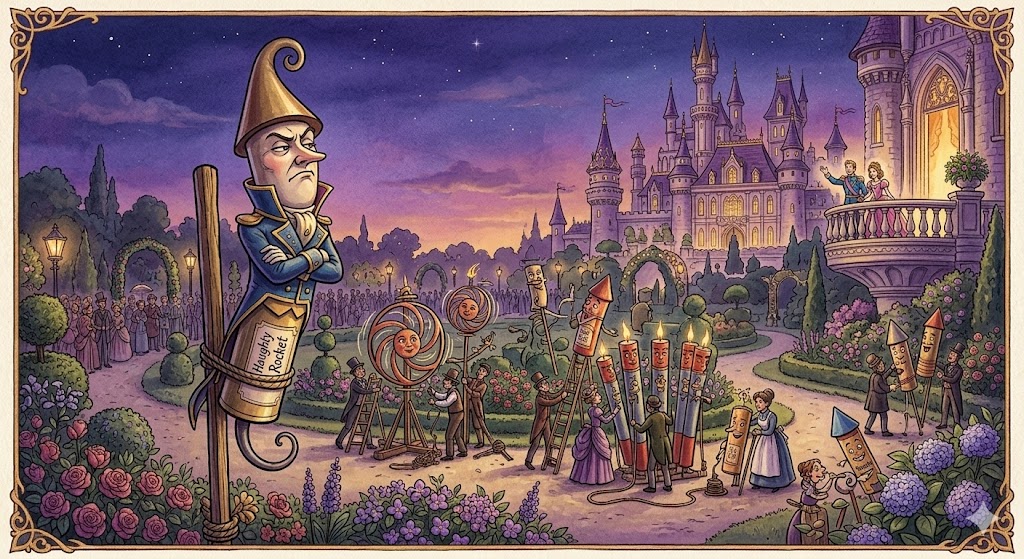
The King’s son was to be married, and the entire kingdom rejoiced. He had waited a whole year for his bride, a Russian Princess who had journeyed all the way from Finland in a sledge shaped like a great golden swan. She was as pale as the Snow Palace she came from, and when she drove through the streets, people threw down flowers, crying, “She is like a white rose!”
At the castle gate, the Prince awaited her. He had dreamy violet eyes and hair like fine gold. When he saw her, he sank to one knee and kissed her hand. “Your picture was beautiful,” he murmured, “but you are more beautiful than your picture.” The Princess blushed, and a young Page whispered, “She was like a white rose before, but now she is like a red rose.”
The marriage was a magnificent ceremony. The bride and groom walked under a canopy of purple velvet embroidered with pearls. At the State Banquet, they drank from a cup of clear crystal that would grow grey and cloudy if false lips touched it. Theirs remained clear. “It’s quite clear they love each other,” said the little Page, and the King doubled his salary—though as the Page received no salary, it was more of an honour than a benefit.
The Fireworks Gather
After the banquet came a Ball, and after the Ball, a grand display of fireworks at midnight. The little Princess had never seen fireworks, so the Royal Pyrotechnist was in attendance. In the garden, as soon as everything was set up, the fireworks began to talk amongst themselves.
“The world is certainly very beautiful,” chirped a little Squib, admiring the yellow tulips.
“The King’s garden is not the world, you foolish squib,” said a lofty Roman Candle. “The world is an enormous place.”
A pensive Catherine Wheel, who prided herself on a broken heart, sighed. “Love is not fashionable anymore. Romance is dead. The poets wrote too much about it, and nobody believes them now.”
Suddenly, a sharp, dry cough demanded attention. It came from a tall, supercilious-looking Rocket tied to a long stick. “Ahem! ahem!” he began, once silence fell. “How fortunate it is for the King’s son that he is to be married on the very day I am to be let off. Really, it could not have turned out better for him. But Princes are always lucky.”
“I thought we were to be let off in the Prince’s honour,” said the little Squib.
“It may be so with you,” the Rocket replied dismissively. “But I am a very remarkable Rocket, from remarkable parents. My mother was a celebrated Catherine Wheel, renowned for her graceful dancing. My father was a Rocket of French extraction who flew so high people feared he would never come down. He made a most brilliant descent in a shower of golden rain. The Court Gazette called him a triumph of Pylotechnic art.”
“Pyrotechnic, you mean,” corrected a Bengal Light.
“I said Pylotechnic,” the Rocket retorted severely.
The Rocket’s Ego
He continued, “I am extremely sensitive. No one in the whole world is so sensitive as I am. I am always thinking about myself, and I expect everybody else to do the same. That is called sympathy. Suppose, for instance, anything happened to me tonight—what a misfortune for everyone! The Prince and Princess would never be happy again.”
The other fireworks grew tired of his vanity. “If you want to give pleasure to others, you had better keep yourself dry,” said the Roman Candle.
But the Rocket, lost in his own importance, imagined tragic scenarios for the happy couple—perhaps they would have a son who might drown in a river. “What a terrible misfortune! I shall never get over it,” he wailed, actually bursting into real tears, which flowed down his stick and nearly drowned two little beetles looking for a home.
The Damp Squib
At midnight, the fireworks began. Whizz! Boom! Bang! The Catherine Wheel spun, the Roman Candle shot stars, the Squibs danced, and the Bengal Lights made everything scarlet. Every firework was a great success except The Remarkable Rocket. He was so damp from crying that he could not go off at all. He simply fizzled pathetically.
“I suppose they are reserving me for some grand occasion,” he said to himself, looking more supercilious than ever as the Court cheered the others.
The next day, workmen came to tidy up. One of them saw the damp, useless Rocket. “Hallo! What a bad rocket!” he said, and threw him over the wall into a ditch.
“Bad Rocket? Impossible!” spluttered the Rocket as he sailed through the air. “Grand Rocket, that is what he said! Bad and Grand sound very much the same.” He landed with a squelch in the mud.
Conversations in the Ditch
A little Frog swam up. “A new arrival! Well, there is nothing like mud. Do you think it will be a wet afternoon? I hope so, but the sky is blue. What a pity!”
“Ahem! ahem!” said the Rocket, trying to get a word in.
“What a delightful voice you have!” cried the Frog. “Quite like a croak. You must come hear our glee-club in the duck pond. We sing by moonlight. It’s so entrancing the farmer’s wife says she cannot get a wink of sleep!” And off he swam to find his daughters.
“Conversation, indeed!” muttered the Rocket. “You talked the whole time!” A Dragon-fly soon left him too, bored by his monologues about his own genius. Then a large White Duck waddled by. “Quack, quack, quack. What a curious shape you are!”
“It is evident you have always lived in the country,” said the Rocket haughtily. “Otherwise you would know I can fly into the sky and come down in a shower of golden rain.”
“I don’t think much of that,” said the Duck. “Now, if you could plough fields like an ox, or draw a cart like a horse, that would be something.”
“My good creature,” sneered the Rocket, “a person of my position is never useful. We have accomplishments. Hard work is simply the refuge of people who have nothing to do.” The Duck, peaceable by nature, quacked “Goodbye” and swam away.
The Final Fizzle
Later, two little boys in white smocks came running down with a kettle and some sticks. “Look at this old stick!” said one, picking the Rocket out of the ditch.
“Old Stick? Impossible! Gold Stick, that is what he said!” thought the Rocket, pleased with the mistake. The boys decided he would help boil their kettle. They piled the sticks, put the Rocket on top, and lit the fire.
“This is magnificent!” cried the Rocket. “They are going to let me off in broad daylight, so everyone can see me!” The boys lay down to nap while the kettle boiled.
The Rocket was very damp, so he took a long time to burn. But at last, the fire caught. “Now I am going off!” he announced, making himself stiff and straight. “I know I shall go much higher than the stars, higher than the moon, higher than the sun! I shall go so high that—”
Fizz! Fizz! Fizz! He went straight up into the air. “Delightful! I shall go on like this forever!” he cried. Then he felt a curious tingling. “Now I am going to explode! I shall set the whole world on fire and make such a noise that nobody will talk about anything else for a whole year!”
Bang! Bang! Bang! The gunpowder exploded. There was no doubt about it. But nobody heard him. The two little boys were fast asleep. All that was left of him was the stick, which fell down on the back of a Goose taking a walk. “Good heavens!” cried the Goose. “It is going to rain sticks!” And she rushed into the water.
“I knew I should create a great sensation,” gasped the Rocket with his last breath. And then he went out, forever.
Final Thoughts
Thank you for staying with us until the very end. We hope these stories touched your heart just as much as they did ours. Oscar Wilde had a unique gift for weaving tales that are at once simple and profound, stories that speak to children and adults alike about love, sacrifice, selfishness, and the true meaning of friendship.
We’d love to hear from you—let us know in the comments where you’re reading from and which of these stories resonated with you the most. Was it the sacrifice of the Happy Prince and his loyal Swallow? The nightingale who gave her life for a love that went unappreciated? The Giant who found redemption through a child? Or perhaps the cautionary tales of the Miller and the Remarkable Rocket?
On a scale of 0 to 10, how would you rate today’s stories?
If you enjoyed this post, please consider sharing it with someone who needs to hear these timeless tales. Your support truly motivates us to keep bringing you more emotional and life-changing stories.
Before you go, there’s another classic story waiting for you. If you were moved by the themes of sacrifice and abandonment in these tales, you’ll find similar depth in our analysis of Mary Shelley’s Frankenstein —another story about creation, responsibility, and the monsters we create when we refuse to love.
Click the link below to continue the journey.
Thank you for being here, and we’ll see you in the next story.
Which story touched your heart the most? Drop your thoughts in the comments below!